
 WHAT makes Liverpool so special? Well, it’s people like pensioner, the late Jack Stamper (left, with his wife Eileen). Jack’s unrelenting tenacity meant that there is a Pier Head memorial to the world’s second worst maritime disaster which occurred 85 years ago this month.
This was the horrific sinking of Liverpool’s Cunard liner HMT Lancastria and the death of up to 7,000 people, on 17 June 1940, during an attempted rescue of military and civilians left behind and cut off from escape after the Dunkirk evacuation as invading German forces swept westwards across France.
Coming at a dire point for the UK in the Second World War, the sinking was so horrific that its reporting was suppressed by the PM Winston Churchill because of its impact on public morale.
Incredibly there was no Merseyside memorial until Jack’s persistence paid off, resulting in a modest plaque unveiled in September 2013 within sight of where Lancastria often berthed, including setting off for that last fateful voyage.
Jack, who was 83 at the time, marched past the Pier Head’s Cunard Building with placard publicising his crusade, during the Battle of the Atlantic 70th anniversary events. He said: “It caused a stir with the public! I was worried the tragedy and huge loss of life would be forgotten.”
Lancastria, with fellow Cunarder Franconia, sailed from Liverpool on 14 June to St Nazaire, in western France, as part of the emergency Operation Aerial to rescue those unfortunate souls cut off by the German advance through France and were forced to flee westwards.
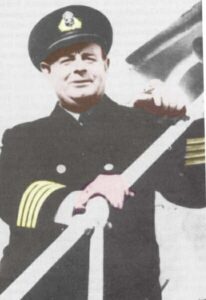
Franconia suffered bomb damage en route and had to limp back to Liverpool. Meantime, Lancastria anchored in the Loire estuary. Orders were given to ignore her licenced wartime capacity of 2,180; however, as Captain Rudolph Sharp, from Shetland (left: Deadline Press) and later Birkenhead, evacuated 2,653 men on a single trip back from Norway, and he replied he could take 3,000 “at a pinch”.
Eventually, it is believed 9,000 poured aboard including women and children, packed into every space including cargo holds. In the panic of boarding, no passenger manifests were kept, hence the vague figures. The grisly title of the world’s worst maritime disaster is held by the Nazi military transport Wilhelm Gustloff which was torpedoed in 1945 with loss of more than 9,300 lives.
In an interview for the Liverpool Daily Post & Echo https://www.liverpoolecho.co.uk/news/liverpool-news/memorial-unveiled-marking-britains-worst-6107724 , Jack, a former builder from Allerton, told me his inspiration came way back: “My interest started in 1945 when I worked at Howson’s ship repairers with a Cunard carpenter, Bob Smith, who survived Lancastria’s sinking against all odds.”
Mr Smith was pitched off Lancastria’s upper deck when the ship rolled over after being attacked by Luftwaffe Junkers Ju 88s. Three or four bombs scored direct hits, with one allegedly going down the funnel, which would account for the ship’s rapid sinking in 15-20 minutes.
“I am delighted to finally have a fitting reminder to all those who lost their lives on board Lancastria and to thank all those who contributed to the plaque,” said Jack, whose wife Eileen accompanied him when the plaque was unveiled by the Lord Lt of Merseyside, Dame Lorna Muirhead.
“Lancastria was a Liverpool ship and had already rescued refugees in Norway from the clutches of Nazism, before she was sent to St Nazaire.
 “There are memorials to Lancastria at St Nazaire, Edinburgh, Staffordshire and London, but most surprisingly, not in Liverpool.”
Like many Lancastria survivors Bob Smith had swallowed heavy oil which spilled out from the liner’s ruptured fuel tanks and permanently damaged his lungs.
He was one of 2,477 survivors who also suffered being strafed in the water by German warplanes, according to Jonathan Fenby, author of The Sinking of the Lancastria.
 Interviewing Jonathan Fenby in 2005, he estimated between 4,000 to 6,500 people died, although other sources say up to 7,000 people perished. This is the largest loss of life in British maritime history, sometimes considered the world’s second worst loss of life at sea. Survivors were ordered not to speak about the appalling ordeal they suffered, although stories started to leak into the local press and it was reported in the US.
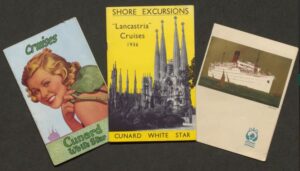 This was a far cry from Lancastria’s prewar languid service as a luxury Mediterranean cruise liner. A former crew member John Sawyer told me he was assigned to lift boy duties: “I looked a cute 14-year-old and did very well with tips! Lancastria was sent cruising as she wasn’t the best seaboat for transatlantic service.”
 In an indirect link from the depths of memory, I recall my father telling he saw someone fall overboard when Lancastria was anchored mid-Mersey and a crew member dived into the river to save them.
In a further awful postscript to this profoundly distressing story, Lancastria’s master Capt Rudolph Sharp was killed while in command of HMT Laconia, the victim of another infamous WWII sinking, dubbed ‘the Laconia incident’.