
WELCOME to my first mini-blog giving a taste of the forthcoming Fizz & Ships maritime themed wine-tasting with my great friend and viticultural expert Jane Clare at The Grand Southport’s Princess Grace Suite, on Friday 21 August 2026. The Grand is the perfect venue as its art deco style is synonymous with luxurious ocean liner style.
We’ll be embarking on our imaginary armchair world cruise aboard famous Liverpool shipping lines calling in at ports across the globe and sampling a well-known wine from that region.
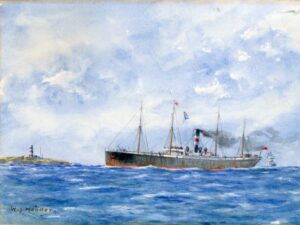 The first leg of our virtual voyage will be aboard Harrison Line’s sturdy cargo liners through the tempestuous Bay of Biscay (don’t worry, being on land The Grand is stabilised and no danger of mal de mare) to western France.
From 1853 Harrison’s was famous for initially importing brandy and then other fine wines from Charente and Bordeaux, so for our first wine tasting we’ll enjoy the fizzy delicacy of a Cremant produced in that region.
In this city of comedians, Harrison Line was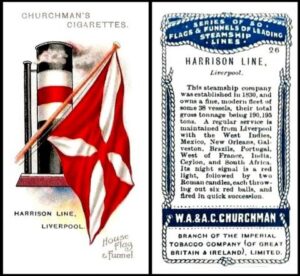 nicknamed ‘Two of fat and one of lean’ as its ships’ black funnels had a red stripe banded by two thicker white stripes. It was less kindly mocked as ‘Hungry Harrisons’ allegedly because of poor food for the crews.
Like so many of the original aspiring Liverpool shipowners, the Harrison brothers, Thomas and James, came from elsewhere (often inland) in their case farmer’s sons from Cockerton, Lancashire.
Albert Dock’s revolutionary bonded warehouses were specially designed in 1846 for the unloading of high-value goods such as these fine wines. Not only was it designed to be fire-proof (no wood involved), but the warehouses were positioned flush with the dockside.
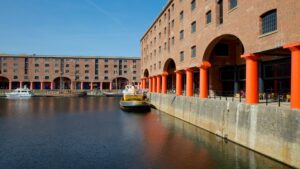 This meant these precious cargoes could be lifted by new-fangled hydraulic cranes directly from the ships’ holds into the warehouses themselves without the goods somehow disappearing in the gap between ship and storage. Clever, eh?
The downside was that within 50 years Albert Dock was practically redundant as marine technology raced ahead, and ships simply became too big to lock in and out of the complex.
Although it sounds like the Albert Dock was a negative innovation, it demonstrates how progressive Liverpool was as Britain’s premier seaport. HRH Prince Albert, husband of HM Queen Victoria, spoke prophetic words as he opened Albert Dock, saying that he’d heard of the wonders of Liverpool, but the reality surpassed his expectations.
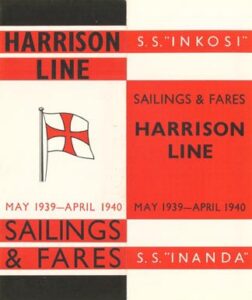 Harrison Line expanded its routes to the US, even having its own quay at Galveston, Texas, for the loading of cotton, a huge import business for Liverpool and the Manchester mill industry. Other services included the Caribbean, India and the Far East.
A fine headquarters called Harrison Chambers was built in 1878 overlooking Liverpool Parish church of Our Lady & St Nicholas – appropriately ‘the seafarers’ church’.
The building boasts the ‘third Liver Bird’ sculpture (the first two being on the Royal Liver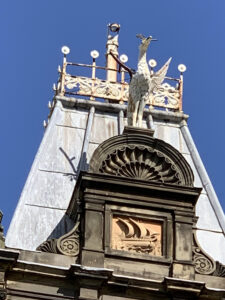 Building opposite), which for years was missing a wing, possibly an omen for the company’s demise in 2000.
I attended the closure of the Harrison Line Museum on the building’s top floor before its fascinating collection of memorabilia was auctioned off (why didn’t such a special collection didn’t go to the Merseyside Maritime Museum?). I was given a print of the poster featured at the top of this piece.
Latest news is that Harrison Chambers’ Liver Bird’s is to have its right wing restored, but the company itself has disappeared over the horizon, another proud part of the city’s maritime history never to return.
- Fizz & Ships, Friday 21 August at 7pm; The Grand, 180 Lord Street, Southport PR9 0QR; thegrand.co.uk ; @SouthportGrand; Tel: 01704 532578; £60 per ‘passenger’.